


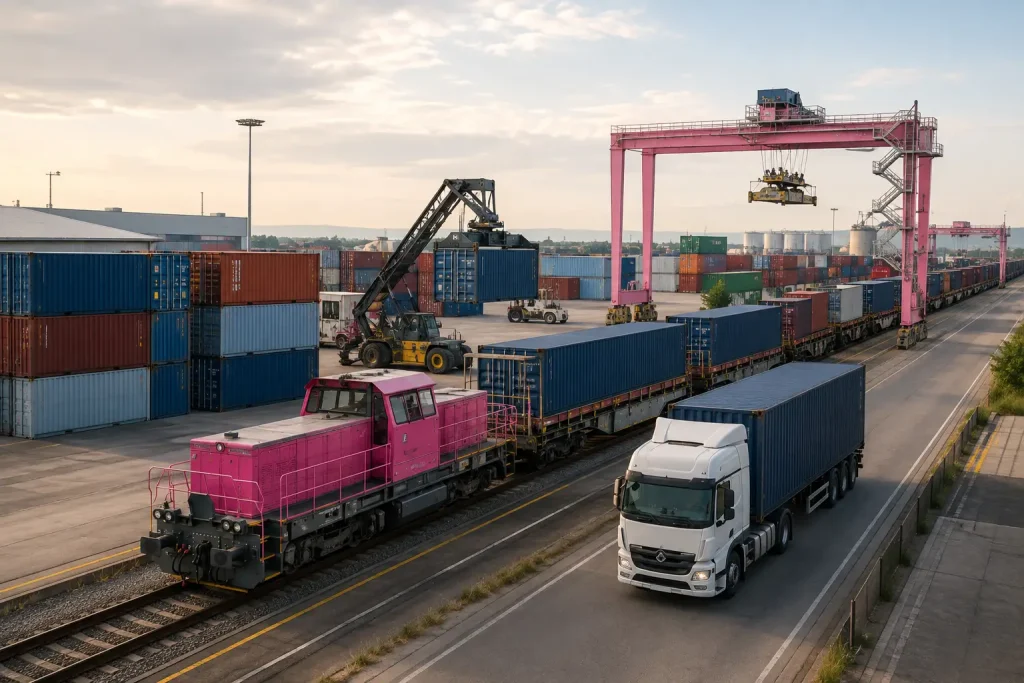
Terrestrial intermodality demonstrates its value when different modes of transport work as coordinated parts of the same logistics chain. Rail, road, inland terminals, ports and customs services need to interact effectively, reducing discontinuities and allowing goods to continue towards their final destination within a coherent organisational framework.
This is the approach through which Contship has progressively developed its presence in terrestrial transport, complementing its port terminal activities with a structure made up of specialised and complementary companies.
Today, this model allows the Group to follow containers from the maritime terminal all the way to the final recipient, while also developing continental connections in which rail and road transport are used in an integrated way.
The structure is also clearly reflected in the data and information provided in the interview with Cristiano Pieragnolo, Chief Commercial Officer of Contship, which formed the basis for this article.
From Sea to Land: How Contship’s Model Has Evolved
Contship’s history began at sea. When Angelo Ravano founded the company in 1969, maritime container transport was still taking its first steps in Europe. The name itself comes from the combination of container and shipping.
Two years later, Contship established Italy’s first privately operated port terminal in La Spezia. In the following years, the company continued to grow in the maritime sector, eventually developing the project that led to the creation of the Gioia Tauro transhipment hub, launched in 1995 and destined to become one of the leading hubs in the Mediterranean.
Following Ravano’s death in 1994, the company continued its development under the leadership of Cecilia Eckelmann Battistello, progressively expanding its activities towards the terrestrial side of logistics.
This evolution has led Contship towards a model in which the port terminal represents one node within a much broader logistics chain.
Five Companies Building an Integrated Terrestrial Supply Chain
Contship’s terrestrial intermodal organisation is based on the specialisation of the Group’s different companies.
Hannibal develops and markets intermodal solutions as an MTO; Oceanogate manages rail traction on the Italian network; Rail Hub Milano operates the inland terminal in Melzo and its handling activities; STS provides customs services; while driveMybox manages road transport, particularly the first and last mile.
The latter originated from GoTrans, acquired in 2023, and operates approximately 100 directly owned industrial vehicles, while coordinating around 350 vehicles in total.
This direct presence across the various stages of the chain makes it possible to build services that can accompany goods from the port to the final recipient’s warehouse or connect two different points across the continent.
Customs activities are also part of this architecture. Through STS and Rail Hub Milano, the Group directly manages customs clearance, documentation and regulatory procedures, helping to ensure greater continuity between maritime terminals and terrestrial transport.
Melzo, the Central Node of the Terrestrial Network
Within this organisation, Rail Hub Milano in Melzo plays a particularly important role.
It is the main terrestrial hub of the Contship system and acts as a connection point between domestic traffic and flows heading towards Northern Europe.
The terminal handles containers and craneable semi-trailers, a type of loading unit that is becoming increasingly important in the development of road-rail intermodality.
The ability to view infrastructure and connections together is also what makes a digital representation of the network particularly useful. Through the PortaleGenio Genio WebApp, users can quickly visualise the facilities, connections and companies that make up the Contship system, observing their geographical distribution within a broader intermodal framework.
The WebApp makes it possible to identify Rail Hub Milano in Melzo, the port terminals in La Spezia, Ravenna and Salerno, the TC2 and TC3 terminals at Tanger Med in Morocco, and the terminal in Damietta, Egypt, while relating these facilities to the other elements of the network.
In this way, information relating to different logistics nodes can be consulted within a single digital environment, helping users understand the scale and geographical structure of the network.
Road and Rail: Flexibility Comes from Integration
Road transport is also organised according to a mixed model.
Just over half of road capacity is provided through directly available vehicles, while the remainder is entrusted to selected external carriers.
Combining these two components provides greater flexibility in managing volumes. Suppliers are selected according to factors including reliability, operational continuity, and economic and environmental sustainability, through a qualification process focused primarily on well-structured companies.
Planning is coordinated by the driveMybox Control Tower, which receives orders and organises daily journeys, including both entirely road-based transport and road legs forming part of an intermodal service.
This approach helps explain a key principle of the model: road and rail are not necessarily considered alternatives.
Their value increases when they are used in a complementary way.
Unaccompanied Semi-Trailers: One of the Segments with the Greatest Potential
One of the most dynamic areas is the rail transport of unaccompanied semi-trailers.
The advantage for customers is significant: the semi-trailer can enter the intermodal chain without requiring the load itself to be transferred.
Contship has been operating services to Rotterdam since 2021. Operations currently involve three terminals, with the document indicating that a fourth is due to be added shortly. From Rotterdam, traffic can also be forwarded towards the United Kingdom and Scandinavia using Ro-Ro connections.
The Group is also looking at Germany as one of the markets with the greatest potential for modal shift, with the stated objective of launching direct connections by the end of 2026.
This development shows how intermodality is progressively expanding beyond the relationship between an Italian port and its hinterland: Melzo becomes part of a continental network in which rail and maritime connections can be combined to reach different European markets.
Modal Shift Still Has Significant Room for Growth
The growth of intermodality, however, does not depend solely on the availability of trains or terminals.
It requires adequate infrastructure, planning capabilities and a change in the way logistics chains are designed.
In many corridors, the all-road model still plays a significant role. Moving towards an intermodal solution means considering several variables together: transit times, economic sustainability, infrastructure availability and environmental impact.
Contship provides first- and last-mile traction services for road-rail connections, both on the Italian side and at destination. A significant proportion of its continental customers are large road haulage companies, which often already have their own traction capacity.
This also highlights how intermodality can complement road transport rather than replacing it entirely.
Declining Road Capacity Makes Integration Even More Important
The issue becomes even more relevant in light of one of the structural challenges facing European transport: the availability of road capacity.
According to Contship, this capacity is progressively decreasing, and the trend could become more pronounced due to the high average age of drivers and insufficient generational turnover.
During periods of peak demand, moreover, the terrestrial component linked to maritime traffic can quickly reach its capacity limits.
Once again, the response lies in cooperation between transport modes.
Building an effective relationship between road and rail makes it possible to distribute flows more efficiently and can increase the overall ability of the logistics chain to respond to fluctuations in demand.
Marcianise–Melzo: A Strategic Connection Constrained by Infrastructure
A concrete example of both the opportunities and limitations of Italian intermodality is the rail connection between Marcianise, in the province of Caserta, and Melzo.
The service carries tanks, containers and swap bodies, moving traffic towards the Lombardy hub, from where it can continue towards Northern Europe.
Semi-trailers, however, cannot yet use this connection via the Tyrrhenian route.
The limitation is infrastructural: on the Florence–Bologna section, the rail loading gauge is not yet suitable for units four metres high. According to the information provided in the source document, the required upgrade is not expected before 2028. The Adriatic line, on the other hand, is already suitable for transporting semi-trailers of this height.
This case clearly shows how the development of modal shift also depends on the continuity of infrastructure standards along the entire corridor.
Data and Artificial Intelligence Enter Rail Planning
Contemporary intermodality is also developing on another level: digitalisation.
Contship is working internally on algorithms for planning and optimising rail flows, with particular attention to train balancing.
The principle is straightforward: for rail to fully express its advantages, trains need to operate with appropriate utilisation levels. Improving load composition and identifying synergies between flows can therefore have a direct impact on the overall efficiency of the service.
This internal activity is complemented by Contship’s participation in Synlog Alliance, a logistics data consortium that the Group helped establish and which was presented at the Contship Logistics Forum in March 2025.
The objective is to facilitate the sharing of operational data among supply chain stakeholders while preserving confidentiality, and to use artificial intelligence to improve efficiency, process reliability and decision-making.
Information fragmentation remains one of the challenges facing the logistics chain: different operators use different systems and languages, making it more difficult to build a shared view of flows.
PortaleGenio: Viewing the Network Within the Intermodal System
The need to make infrastructure, connections and operators easier to understand is also central to the approach of PortaleGenio.
The Genio WebApp allows users to explore the intermodal network and connect different elements of transport, including terminals, ports, freight villages, airports, rail connections, Ro-Ro routes and operators.
In Contship’s case, this means moving from a description of the model to its geographical representation, identifying the Group’s main nodes in just a few steps and observing how they fit into national and international transport networks.
The ability to visualise facilities and connections within the same digital environment helps make one of the fundamental principles of intermodality more tangible: the value of a terminal also depends on the network of connections in which it operates.
Sustainability: From HVO Trials to the Net Zero Target
The evolution of the model also involves sustainability.
As part of its Moves That Matter corporate sustainability strategy, Contship has launched trials involving the use of low-emission fuels in road transport, with particular focus on HVO, with the aim of reducing CO₂ emissions.
Electric traction is being monitored with interest, but according to Contship it is not yet considered sufficiently mature to meet the operational requirements of the sector, particularly given the current Italian infrastructure landscape.
The Group’s stated long-term objective remains Net Zero by 2050, assessing along the way the technologies capable of generating both environmental and economic benefits.
Intermodality as the Ability to Coordinate a Network
The Contship case therefore illustrates an approach to intermodality that goes far beyond simply transferring a container from road to rail.
Port and inland terminals, rail traction, road haulage, customs services, international connections, data and digital tools all contribute to the construction of a single logistics chain.
And this is perhaps one of the most interesting aspects of the transformation currently under way: competitiveness depends not only on individual infrastructure or individual modes of transport, but on the ability to create efficient relationships between different nodes.
The development of rail transport for semi-trailers, expansion towards new European corridors, data-driven flow optimisation and investment in sustainability all point in a clear direction.
A direction in which understanding the network becomes as important as understanding the individual players within it. This is where information tools such as PortaleGenio and the Genio WebApp can provide valuable support in understanding European intermodality and the relationships that determine how it works.