


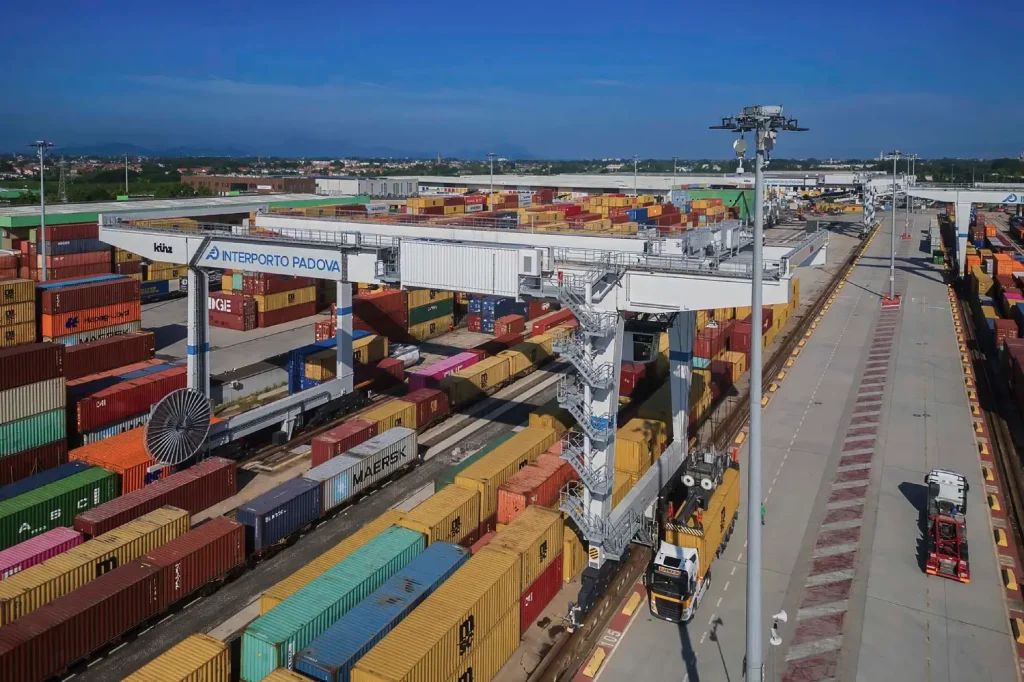
The intermodal terminal at Interporto Padova is entering a new phase of development. The creation of PSA Padova, a company established by PSA Intermodal Italy, Logtainer and Interporto Padova, represents much more than a change in terminal management: the operation brings the Veneto hub into PSA’s Node-to-Network (N2N) strategy, with the aim of strengthening its connections with ports, other inland terminals and Europe’s main logistics corridors.
Following the award of the tender concluded in December 2025, the agreement marks the transition to the implementation phase of the project. The Padua terminal thus becomes part of a strategy in which port and inland infrastructure are considered nodes within the same network, with rail expected to play an increasingly important role in long-distance connections.
From a Terminal to a Node in a Broader Intermodal Network
To understand the significance of the operation, it is useful to start with the concept of Node-to-Network itself.
The idea is to move beyond viewing infrastructure as a collection of isolated elements. An inland terminal generates greater value when it is efficiently connected to seaports, other inland terminals, industrial areas and major European transport corridors.
Padua is therefore being integrated into a broader network, connected with the TEN-T corridors, with the aim of increasing the opportunities for North-Eastern Italy to connect with major maritime and logistics gateways.
In this context, the terminal does more than simply handle loading units. It becomes a point for concentrating and distributing flows, capable of connecting the inland manufacturing system with national and international networks.
This approach reflects one of the fundamental principles of modern intermodality: the competitiveness of an infrastructure increasingly depends on the quality of the connections it is able to establish with the other nodes in the network.
PSA Intermodal Italy, Interporto Padova and Logtainer: Three Complementary Areas of Expertise
The structure of the new company reflects this approach.
PSA Intermodal Italy holds the majority stake and assumes operational responsibility for PSA Padova. Its strategic contribution lies above all in the opportunity to integrate the terminal into a broader network of maritime and inland infrastructure and to apply an integrated model to the management of logistics flows.
Interporto Padova, meanwhile, retains a minority stake. Its role helps preserve the connection with the local area and ensures that the terminal’s development remains aligned with regional logistics strategies and with the transition towards the new Interporto Padova Hall Spa structure.
The third partner is Logtainer, which brings its rail and intermodal expertise to the agreement.
The operator manages approximately 6,000 trains per year and has an established presence along some of Italy’s main container transport corridors, connecting ports such as Genoa and La Spezia with inland terminals including Pioltello, Rubiera and Padua.
The integration of these three areas of expertise therefore brings together terminal management, local knowledge, an international network and rail transport.
Rail as a Key Driver for Extending the Reach of Ports
One of the central aspects of the project concerns the role of rail transport.
For a port, having efficient connections with inland terminals means being able to extend its reach beyond the areas immediately surrounding the docks. For an industrial region such as North-Eastern Italy, meanwhile, it means being able to access maritime gateways through alternatives to long-distance road transport.
Logtainer’s know-how is expected to help strengthen this component by increasing the capacity and reliability of connections between Padua and the ports.
The stated objective is to improve the terminal’s port connectivity and increase its operational efficiency, making the hub more competitive for freight forwarders, shipping companies and businesses in North-Eastern Italy.
The expected outcome is therefore not a competition between road and rail. Intermodality is instead based on using each mode where it can be most effective: rail for distances and flows suited to rail transport, and road primarily to ensure widespread distribution and first- and last-mile connections.
More Than 520,000 Square Metres Dedicated to Rail and Terminal Operations
The project can already rely on a significant infrastructure base.
Interporto Padova has more than 520,000 square metres of rail and terminal areas, supported by a high level of automation and digitalisation in flow management.
These are important characteristics because increasing intermodal traffic does not depend solely on the availability of rail connections. Adequate space, handling capacity, efficient yard organisation and systems capable of coordinating growing volumes are also essential.
Integration into the N2N strategy therefore aims to enhance existing infrastructure by connecting it to a broader network.
And it is precisely this network dimension that can also be explored through PortaleGenio.
By using the Genio WebApp, users can analyse the Padua terminal within its intermodal context, visualising its connections with ports and its relationships with other inland terminals. This representation makes it possible to move from the individual infrastructure to the network of which it forms part, making it easier to understand the synergies generated by the arrival of new players in the terminal’s management.
Genio Also Makes It Possible to Explore the Infrastructure’s Characteristics
Viewing connections is only one of the useful aspects when it comes to understanding the role of a logistics hub.
Through the PortaleGenio WebApp, users can also consult information on the technical characteristics of Padova Interporto Terminal and Interporto Padova, placing them within the broader framework of European intermodal infrastructure.
This makes it possible to analyse two dimensions simultaneously: on the one hand, what an infrastructure offers and, on the other, how that infrastructure is connected to the rest of the system.
In the case of PSA Padova, this perspective is particularly relevant because the industrial value of the agreement lies precisely in the combination of the terminal’s characteristics, new management expertise and the expansion of its network connections.
The Role of the TEN-T Corridors
Padua’s location becomes even more significant when considered in relation to the Trans-European Transport Network (TEN-T).
The European corridors are designed to create a more integrated, interoperable and efficient transport network by connecting ports, terminals, urban nodes and industrial systems.
For an inland terminal, being effectively integrated into this system means being able to perform a role that extends far beyond the local level.
This is precisely the objective of the strategy outlined for PSA Padova: to consolidate the terminal as a hub capable of serving Veneto’s industrial system while also integrating it into national and international flows.
North-Eastern Italy has a strong concentration of industrial activity and, consequently, significant demand for transport. Improving rail accessibility to ports and European networks can help provide businesses with a wider range of logistics solutions.
An Industrial Strategy Before a Corporate One
The creation of PSA Padova can also be viewed from another perspective.
The new company brings together partners pursuing complementary objectives.
For PSA, Padua represents an inland hub through which it can extend the reach of its network in North-Eastern Italy and strengthen connections between inland and port terminals.
For Interporto Padova, the arrival of an international operator offers an opportunity to develop capacity, connections and services while maintaining a strong local presence.
For Logtainer, the project provides an opportunity to further consolidate its role in containerised rail flows between ports and inland terminals.
This complementarity lies at the industrial heart of the agreement.
The ultimate objective is to build a terminal that is more connected, efficient and capable of handling greater volumes, while offering service standards suited to the needs of companies and supply chains in the Padua and Veneto area.
Intermodality and Sustainability: Reducing Long-Distance Road Transport
The development of the rail component inevitably also introduces an environmental dimension.
Increasing the proportion of goods transported by rail over longer distances can help reduce reliance on road haulage for the same journeys, while leaving road transport with an essential role, particularly in widespread distribution.
In this sense, intermodality is not only about operational efficiency.
A more rational combination of rail and road can help reduce emissions associated with supply chains and make connections between industrial areas and ports more sustainable.
For PSA Padova, therefore, capacity growth, service quality and sustainability become different aspects of the same development path.
Padua and the Future of Logistics in North-Eastern Italy
The creation of PSA Padova provides an interesting example of how the role of inland terminals is changing.
They are no longer simply places where goods move from one mode of transport to another, but nodes through which broader networks can be organised, connecting industrial regions, ports and international corridors.
Padua already benefits from significant infrastructure and extensive experience in intermodal transport. Its inclusion in the Node-to-Network strategy now adds another dimension: integration with an international network.
The real measure of the project will, of course, be its operational development and its ability to translate this new corporate structure into increasingly effective connections, frequencies, capacity and services.
But the direction is already clear: strengthening Padua’s role as an intermodal hub for North-Eastern Italy and as a connection point between the Italian industrial system, ports and European logistics networks.
This development can also be explored through PortaleGenio and the Genio WebApp, by connecting information on the technical characteristics of infrastructure with port and rail connections and other inland terminals.
Because in intermodality, understanding a node increasingly means understanding the network that surrounds it.