

The future of logistics increasingly depends on the ability to connect ports, infrastructure, businesses, and regions. In this context, Genoa aims to strengthen its position as a key logistics hub in the Mediterranean, building on its maritime heritage and developing new opportunities for international cooperation.
A recent proposal submitted to the Genoa City Council outlines a strategy that views logistics not simply as the movement of goods, but as a system capable of driving economic growth, innovation, and new trade relationships.
An Integrated Strategy for Logistics and the Blue Economy
At the heart of the proposal is the creation of a permanent working group dedicated to logistics and the Blue Economy, bringing together institutions, port authorities, universities, businesses, and industry organisations.
The aim is to develop a three-year plan coordinating investment, training, innovation, and sustainability initiatives to strengthen the competitiveness of Genoa’s logistics system.
Key priorities include digitalising port access procedures, improving freight flow management, developing parking and rest areas for heavy goods vehicles, and enhancing information sharing among logistics operators.
If implemented, these measures could help reduce congestion, waiting times, and costs associated with transport inefficiencies.
The Mediterranean as a Hub for International Trade Networks
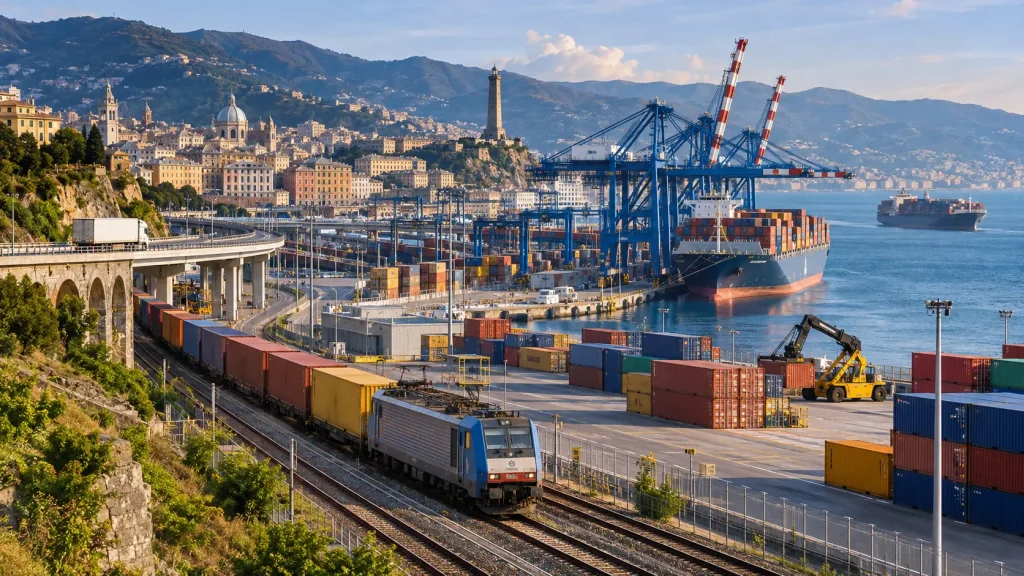
Genoa’s geographical position makes it a strategic hub for connections between the Mediterranean, continental Europe, and international markets.
Today, however, a port’s competitiveness depends on more than its ability to accommodate ships and handle containers. The quality of its connections to intermodal terminals, inland logistics hubs, and railway networks is becoming increasingly important.
From this perspective, intermodal transport is a key driver of development, enabling maritime, rail, and road transport to be integrated into a broader vision of the logistics chain.
Combining these transport modes can support more efficient freight management and, where operating conditions allow, help reduce the environmental impact of transport.
PortaleGenio: Making European Logistics Connections Visible
Understanding the relationships between ports, terminals, and infrastructure is an important step towards encouraging more businesses to explore intermodal transport.
This is precisely the idea behind PortaleGenio: making Europe’s complex network of transport connections visible through a simple and intuitive interface.
For the first time, the project provides industry users with an integrated view of maritime and rail trade routes within the wider European intermodal network.
Through the Genio WebApp, users can explore over 500 European short-sea shipping connections and thousands of rail connections, while also viewing ports, inland logistics hubs, terminals, and TEN-T corridors.
It is an information platform that helps users better understand existing infrastructure, identify available connections, and explore the opportunities offered by intermodal transport.
The ability to actually see these connections, rather than relying on fragmented information, can make the logistics network easier to understand and help operators make more informed transport decisions.
International Cooperation and Innovation: Genoa’s Future Prospects
The Genoa proposal also places particular emphasis on cooperation between port cities, institutions, and international business networks.
Trade missions, exhibitions, and industry events could provide opportunities to strengthen economic relationships and promote Genoa as an integrated hub for port, industrial, and logistics activities.
Alongside infrastructure development, training new professionals capable of responding to the sector’s digital and energy transitions is becoming increasingly important.
This vision extends beyond Genoa to the entire European transport system: developing more efficient connections requires investment, cooperation, and an increasingly detailed understanding of existing networks.
PortaleGenio is part of this evolution, helping to make information about the European intermodal transport system more accessible.
Because understanding and visualising available connections is one of the first steps towards unlocking the opportunities of a more integrated, competitive, and sustainable logistics system.
News source: Ship2Shore, 8 September 2026