


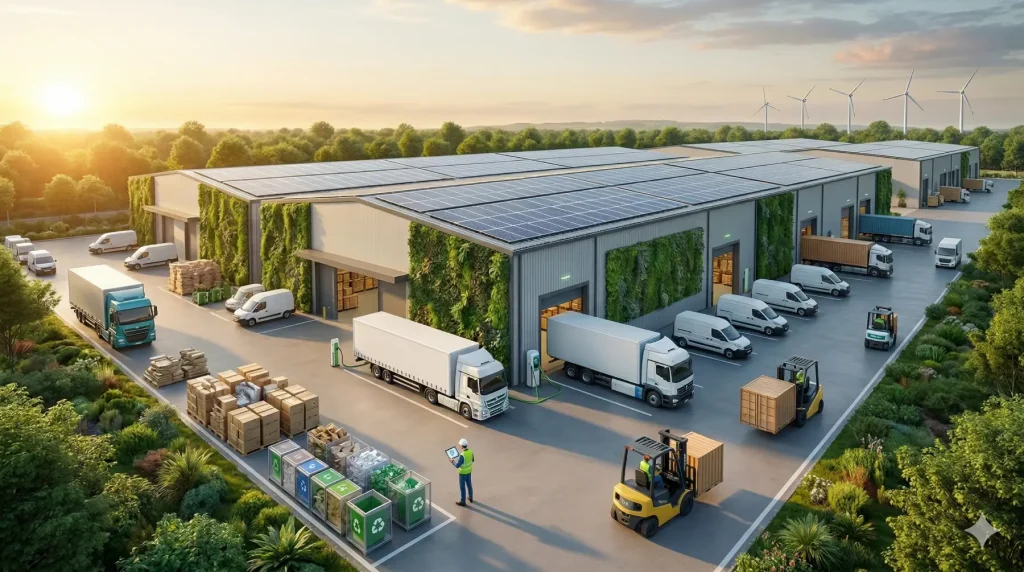
In the logistics sector, ESG (Environmental, Social, Governance) has undergone a clear transformation — increasingly evident for some time now — from a regulatory constraint to a strategic factor.
This is not a theoretical shift, but a tangible evolution of the market. Logistics, by its nature, is one of the most impactful sectors in environmental terms, contributing significantly to global emissions and therefore playing a central role in the climate challenge.
For this reason, what was once perceived as an obligation — regulations, standards, reporting — is progressively becoming an opportunity.
When sustainability changes the way companies compete
For years, the sector has been driven by two main priorities: operational efficiency and cost reduction.
Today, these levers are no longer sufficient.
Sustainability has become part of how companies are evaluated, not only from a regulatory perspective, but also as a competitive factor. Businesses are therefore required to measure, manage, and communicate their ESG impact in a structured way.
International standards such as the GLEC Framework have contributed to creating a shared language, making it possible to compare data and performance across different operators.
The result is clear:
those able to demonstrate concrete and verifiable data not only comply with regulations, but also position themselves more effectively in the market.
The market is already selecting
A key element already emerging in the sector is the growing pressure from demand.
Major international players are no longer evaluating partners based solely on cost and efficiency. They increasingly require concrete ESG evidence.
This creates a clear divide:
- structured companies → greater access to complex and international supply chains
- non-aligned companies → risk of exclusion
ESG is therefore not a future topic, but an active filter in current competitive dynamics.
From cost to investment
A crucial shift concerns how sustainability is perceived.
In the past, it was seen as a cost. Today, it is increasingly viewed as an investment.
Some examples make this clear:
- energy-efficient warehouses reduce both consumption and operating costs
- low-emission fleets improve environmental impact while lowering expenses
- flow optimization increases productivity and reduces waste
In this context, sustainability and efficiency are no longer in opposition, but part of the same process.
The central role of data
To turn ESG into a real lever, one key element is required: the ability to measure.
Collecting, organizing, and interpreting data allows companies to:
- understand their impact
- identify areas for improvement
- communicate credibly to the market
ESG data management is no longer just a technical activity, but a strategic component that guides business decisions.
A transformation involving the entire supply chain
Logistics is an interconnected system.
This means sustainability cannot be addressed by individual players in isolation. Any improvement only has value if it extends across the entire chain.
For this reason, ESG is taking on a broader role:
- it becomes a shared language between companies
- it requires collaboration and transparency
- it promotes shared development models
This is a cultural shift before being an operational one.
The link with intermodality
Within this transformation, intermodality represents one of the most concrete levers for reducing the environmental impact of transport.
Integrating different modes — such as rail and maritime — allows optimization of flows and reduction of emissions compared to road-only transport.
In this context, informational tools such as the PortaleGenio WebApp enable users to clearly visualize the European intermodal network and identify available alternatives.
Through detailed visualization of connections, PortaleGenio helps companies better understand existing opportunities, supporting more informed logistics decisions.
Conclusion
ESG has already moved beyond the stage of being considered a simple obligation.
Today, it directly impacts:
- competitiveness
- market access
- innovation capacity
For the logistics sector, this means facing a profound transformation, where sustainability and efficiency are no longer alternatives, but complementary elements.
In this scenario, the ability to interpret data, understand available infrastructure, and identify new solutions becomes a decisive factor in remaining competitive.