


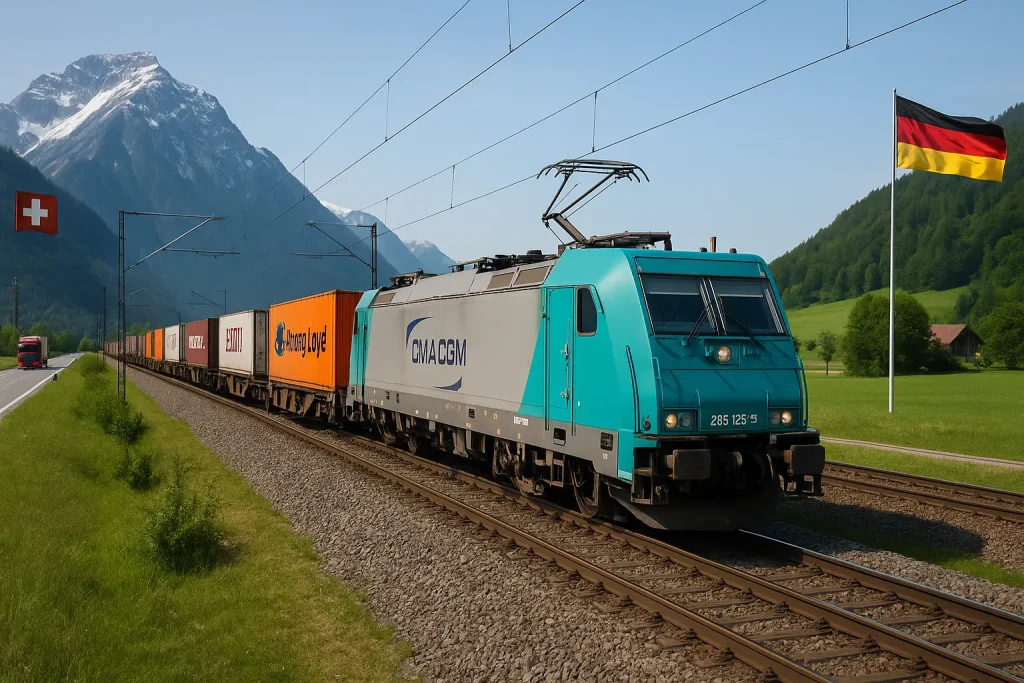
While the European Union continues to promote the modal shift from road to rail to reduce emissions, paradoxically, two of the continent’s logistics powerhouses — Switzerland and Germany — have become critical risk factors for the future of rail freight transport.
A dangerous mix of tougher regulations and long-term infrastructure closures is sparking alarm among businesses, logistics operators, and institutional stakeholders. These concerns were raised at the recent MercinTreno Forum in Rome, where sector experts warned of a looming crisis.
Switzerland: New Rules, Fleets at Risk
It all began with a serious accident in 2023 in the Gotthard Base Tunnel. A freight train derailment, caused by a broken wheel, led to over €150 million in infrastructure damage. The Swiss Transportation Safety Investigation Service (SISI) found that the new LL brake shoes (low-noise/low-friction) may increase the risk of wheel overheating and breakage.
In response, the Swiss Federal Office of Transport (FOT) issued stricter requirements: minimum wheel diameters of 864 mm (up from 860), more frequent maintenance, and certified documentation for every railcar. This change could render thousands of European freight cars non-compliant, severely impacting traffic on the North-South corridor — a critical lifeline for Italian exports.
Although the enforcement deadline has been extended to December 31, 2026, uncertainty remains high.
Germany: Mega Construction Sites and Route Closures
Across the border, Germany is launching a vast infrastructure overhaul, partially funded by Next Generation EU funds. The plan involves closing 40 rail routes between 2026 and 2032, with a peak disruption in 2028, when a major corridor between Italy and Germany — currently used by over 200 freight trains per day — will be shut down for four months.
The consequences? Route detours increasing by up to 400%, inflated costs, and widespread delays. This contrasts sharply with the Italian network, where RFI (Italian Rail Network) typically maintains service continuity even during major works.
Operators Sound the Alarm
Clemente Carta, president of Fermerci, warns of a potential system-wide shutdown:
“Germany and Switzerland are our gateways to Central and Northern Europe. If they stop, everything stops.”
Both Fermerci and Fercargo are calling for real international coordination involving infrastructure managers, governments, and companies to better plan works, find alternative routes, and limit the logistical fallout.
In Italy, Carta urges RFI to open up time slots currently reserved for passenger trains, allowing freight to keep moving — at least until the end of the disruption period in 2027.
Digital Tools for a Flexible Response
In this turbulent scenario, practical tools are essential for businesses to navigate uncertainty and plan flexibly. This is where digital solutions like PortaleGenio can make a significant impact.
Thanks to its free, user-friendly web app, PortaleGenio enables users to:
- Visualize main European rail and Ro-Ro connections
- Explore alternative routes and traffic corridors
- Monitor infrastructure conditions
- Identify potential logistics hubs
This provides a strategic advantage for companies dealing with the instability of the European rail network.
2026: A Critical Year for the Sector
While the Italian PNRR (National Recovery and Resilience Plan) investments are expected to have positive effects, the decisions made by Switzerland and Germany could undermine these efforts. The future of European rail intermodality hinges on the ability to work as a system and adopt digital tools that support real-time adaptation.
For logistics professionals, now is the time to strengthen collaboration, embrace digital innovation, and equip themselves with the right resources.
Among these, PortaleGenio stands out as a free and constantly updated platform — a digital ally to stay ahead of disruptions and plan for a more resilient logistics future.
Explore the WebApp at www.portalegenio.it
For more information, contact: info@portalegenio.it