


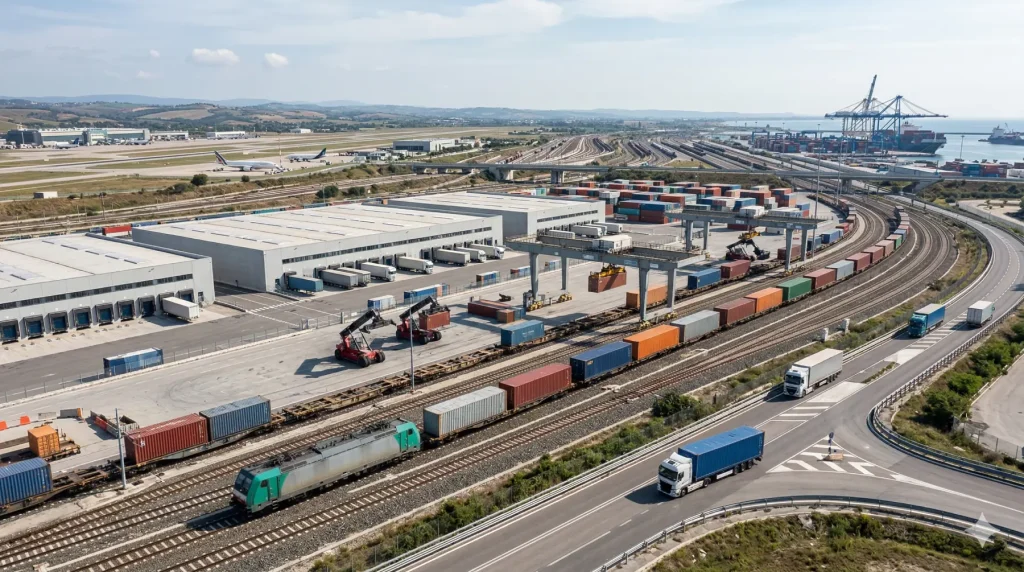
With the entry into force on 11 December 2025 of Law No. 177 of 13 November 2025, Italy’s freight village system enters a new regulatory phase. This long-awaited measure—more than twenty years in the making—has been designed to update outdated rules and finally provide a clearer framework for the planning and governance of Italian freight villages.
It is not an immediate revolution, nor a reform backed by extraordinary infrastructure investments, but it is still a strategic milestone: it better defines roles, responsibilities, and coordination tools at a time when intermodality is becoming increasingly central to the country’s competitiveness.
Freight Villages Become Strategic National Infrastructure
One of the most important aspects of the new legislation is the full recognition of freight villages as essential nodes in the national logistics chain, no longer viewed merely as local infrastructures but as strategic components of the transport system.
The law assigns them a key function:
- promoting intermodality between road, rail, sea, and air;
- supporting business competitiveness;
- improving the efficiency of national and international logistics flows.
This approach fits into a European context in which connection with TEN-T corridors and the continental intermodal terminal network is indispensable for keeping Italian logistics competitive.
National Planning: Maximum 30 Freight Villages
Among the most significant innovations is the introduction of a national mapping of existing and under-construction freight villages, together with the provision of a maximum limit of 30 freight villages across Italy.
The aim is to avoid fragmentation and dispersion, encouraging more rational planning aligned with real logistics market needs.
Within one year of the law’s entry into force, the official survey of infrastructures must be completed, forming the basis for the future National Logistics and Intermodality Plan.
National Committee for Intermodality and Logistics Established
The reform also introduces a new coordination body: the National Committee for Intermodality and Logistics, which will bring together:
- the competent Ministry,
- the Regions involved,
- the Italian Freight Villages Union (UIR),
- the presidents of freight villages.
This body is intended to reduce fragmented decision-making and create more coordinated governance capable of responding more effectively to sector challenges.
A Reform Still to Be Completed: The Issue of Implementing Decrees
Many of the law’s practical effects will now depend on implementing decrees, which must define:
- project financing criteria;
- operational rules of the National Committee;
- application tools for planning.
Without these steps, there is a risk that the reform will remain incomplete at the operational level.
From Localism to a European Dimension
One of the most innovative aspects of the law is the move beyond localistic approaches that for years have limited the coordinated development of Italy’s freight village system.
The new law pushes toward a supra-territorial vision, consistent with:
- the growth of global logistics flows;
- the reorganization of European supply chains;
- the new EU Regulation 2024/1678 on TEN-T corridors.
In this scenario, the ability to connect Italian freight villages with major European logistics hubs becomes a decisive factor.
PortaleGenio: Italian Freight Villages at the Center of the WebApp
Precisely because freight villages are taking on an even more strategic role today, it is essential to be able to understand and analyze them simply and immediately.
Within the PortaleGenio WebApp, among nearly 600 mapped European infrastructures, Italian freight villages are given particular prominence: each one includes:
- a detailed technical profile,
- geolocation,
- links to intermodal terminals,
- connections with ports and airports,
- operators active within the facility.
This function makes PortaleGenio not only an informational tool, but also a true “digital showcase” to enhance services, infrastructures, and new opportunities offered by freight villages.
Looking ahead, this data can be further expanded to promote new functionalities and improve the visibility of individual logistics hubs across the European market.
Challenges for Operators: Attractiveness and Competitiveness
The reform assigns freight village operators a dual responsibility:
- strengthening the role of freight villages in their territories;
- improving connections with major international logistics flows.
This means investing in:
- efficient rail connections;
- modern infrastructures;
- relationships with ports, airports, and European hubs;
- digital innovation.
The future of Italian freight villages will depend on their ability to evolve from static infrastructures into dynamic platforms integrated into European logistics corridors.
A Necessary Reform to Be Turned into Opportunity
The new framework law does not solve every critical issue in the sector, but it marks an important step toward a more modern, coordinated, and competitive logistics system.
If properly implemented, it can help to:
- redefine the national logistics geography;
- strengthen Italy’s role in European freight flows;
- foster real growth in intermodality.
And along this path, tools like PortaleGenio become valuable allies in reading, understanding, and enhancing the evolution of the Italian freight village system.