


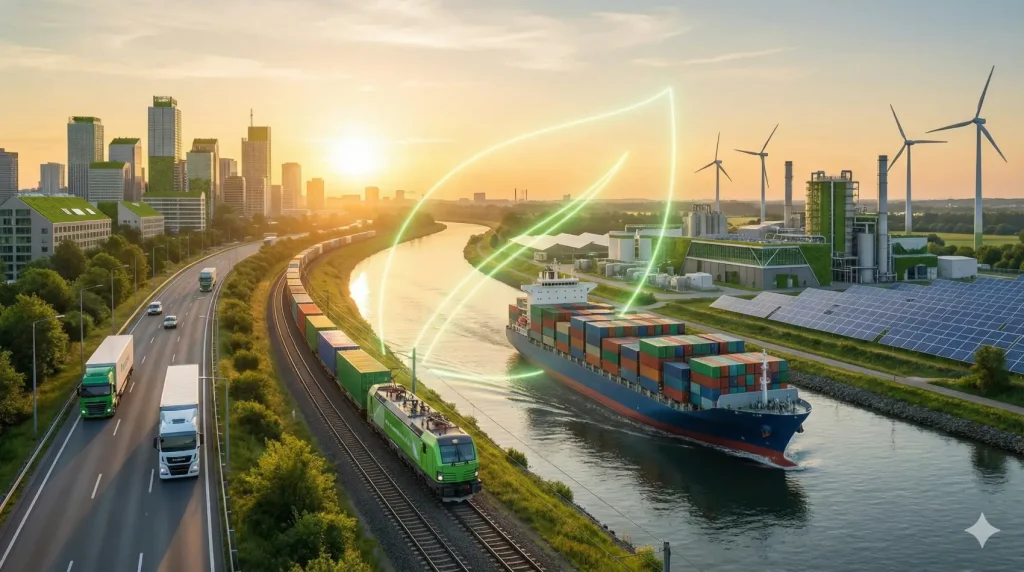
In the transport and logistics sector, sustainability is not a slogan. It is a structural condition: it means ensuring continuity of flows, efficiency of networks, stability for businesses and quality employment. In other words, it means “holding together” a complex system made up of infrastructure, technology, regulations and people.
The 2026 Budget Law, approved in a context marked by geopolitical instability and economic transition, intervenes precisely on these balances. The measures introduced do not yet constitute a fully organic reform of national logistics, but they outline a framework of opportunities that deserves careful analysis, especially from an intermodal perspective.
Excise Duties and Fiscal Leverage: The Transition Must Be Supported
The gradual realignment of excise duties between diesel and gasoline, with compensatory mechanisms for more efficient vehicles, fits into a fiscal harmonization strategy aligned with environmental goals. The principle is clear: those who invest in lower-impact technologies should be rewarded.
However, sustainability cannot translate into an immediate financial burden for companies that choose to innovate. Without fast and accessible financial tools, the risk is slowing down precisely the transformation the policy intends to encourage. The energy transition, to be concrete, must be economically sustainable across the entire supply chain.
Intermodality: Incentives Must Become Structural
Measures such as Ferrobonus, Marebonus and the development of Simplified Logistics Zones (ZLS) represent strategic levers to strengthen intermodality and improve integration between road, rail and sea.
Combined transport remains one of the most effective tools to reduce emissions, ease road congestion and increase the resilience of the national logistics system.
The key issue remains stability. Annual incentives or measures subject to regulatory uncertainty do not allow medium- to long-term industrial planning. To truly transform Italian logistics, a multi-year vision is required, along with simplified authorization procedures and clear access mechanisms.
In this context, the availability of a large amount of useful data for day-to-day intermodal operations becomes a strategic asset. Digital tools such as the PortaleGenio WebApp help support companies in their operational decisions and in assessing more sustainable alternatives.
Industry 4.0 and Green Investments
The reinstatement of environmental super-amortization and Industry 4.0 hyper-amortization allows logistics operators to plan investments in:
- Low- or zero-emission vehicles
- Advanced tracking systems
- Fleet optimization technologies
- Process digitalization
The logistics of the future will be more sustainable, but also more intelligent and integrated. Sensors, telematics, predictive management and digital platforms are now essential components for reducing both costs and environmental impact.
To be truly effective, these measures must also be accessible to less capitalized companies, which represent a significant portion of Italy’s productive fabric.
Human Capital: The Decisive Variable
Tax relief for new hires represents an important step forward in a sector that has long suffered from a structural shortage of skills and generational turnover challenges.
Investing in technical and managerial training means strengthening:
- The capacity to manage intermodal networks
- The conscious use of new technologies
- A sustainability-oriented logistics culture
The sector needs a true logistics–work–education pact capable of connecting businesses, territories and the education system. Without adequate skills, even the best infrastructure risks failing to express its full potential.
Three Strategic Directions for a Logistics System That Endures
The measures contained in the 2026 Budget lay interesting foundations. To translate these premises into structural change, three strategic actions are necessary:
- Make intermodal support stable and multi-year, with simple and predictable tools.
- Establish a dedicated transition fund to support companies in adopting sustainable technologies.
- Build an integrated education–business system capable of sustaining competitiveness in the medium term.
Sustainability, in its original meaning, is what endures over time. Logistics — often invisible to the final consumer — is one of the structural pillars of the real economy.
If governed coherently, it can become:
- An accelerator of the ecological transition
- A driver of territorial cohesion
- A multiplier of competitiveness for Italian industry
To achieve this, forward-looking policies, advanced digital tools and an increasingly widespread intermodal culture are required.