


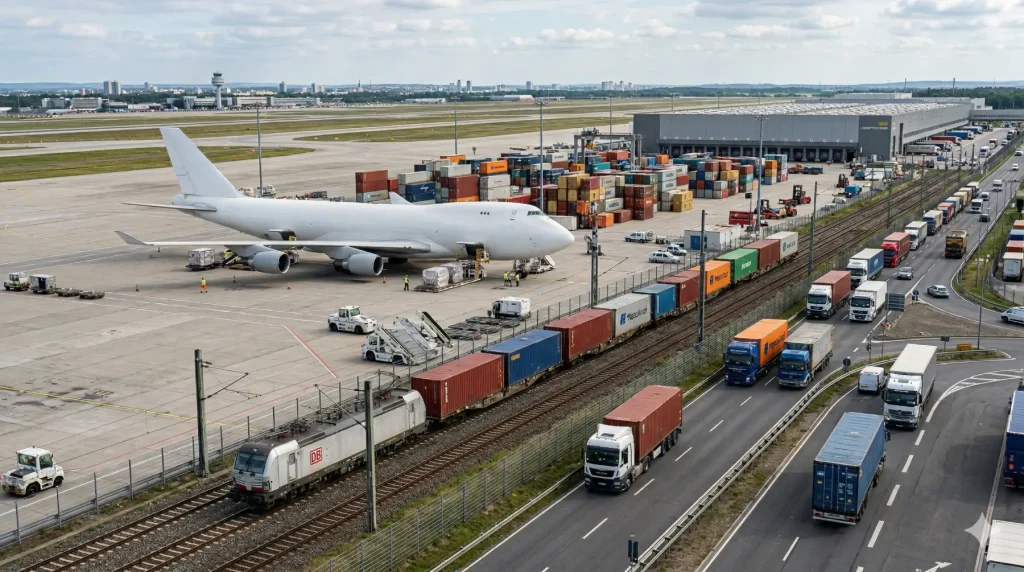
ENAV’s entry into ALIS represents an important signal for the future of integrated mobility in Italy and Europe. It is not simply a new association membership: it is concrete recognition that air transport is now a strategic component of modern intermodality, alongside rail, sea, and road transport.
In a logistics system increasingly focused on sustainability, speed, and network connectivity, integrating civil aviation into intermodal processes becomes both natural and necessary.
A strategic alliance for sustainable mobility
With the official signing of ENAV’s membership in ALIS, collaboration is strengthened between two central players in the transport sector: on one side, Italy’s leading air navigation service provider; on the other, one of the most active associations promoting sustainable intermodality.
ENAV brings into this network its expertise in air traffic management, built through:
- more than 4,500 employees;
- air navigation services across all Italian airspace;
- operations in 45 national airports;
- presence in 85 countries worldwide.
As Pasqualino Monti, CEO of ENAV Group, emphasized, intermodality is now a much more widely understood concept than in the past, also thanks to ALIS’s work in making it more accessible and tangible for the market.
Intermodality now includes the sky
For years, the concept of intermodal transport was associated almost exclusively with the interaction between trucks, trains, ports, and terminals. Today, that picture is changing.
Air transport is now entering intermodal logic in a major way, especially for:
- urgent and high-value goods;
- international first-mile / last-mile connections;
- high-speed supply chains;
- integration with multimodal logistics hubs.
This evolution reflects a real market need: building increasingly interconnected networks capable of combining speed, sustainability, and flexibility.
The growing role of airports in European logistics
ENAV’s entry into ALIS also highlights another crucial aspect: airports are no longer simply passenger traffic nodes, but true strategic logistics hubs.
Across Europe, the connection between airports, intermodal terminals, and TEN-T corridors is becoming increasingly decisive in order to:
- optimize delivery times;
- reduce infrastructure bottlenecks;
- improve multimodal planning;
- make international supply chains more efficient.
PortaleGenio expands its vision: air transport now enters the WebApp
This is precisely where the evolution of PortaleGenio comes into play, continuously expanding its information ecosystem to offer an increasingly complete view of European intermodal mobility.
Alongside rail terminals, seaports, freight villages, rail connections, and Ro-Ro routes, the WebApp now also includes a dedicated section for air transport, featuring:
- 82 mapped European airports,
• operators present in major hubs,
• 340 detailed strategic air routes.
This is a natural extension of PortaleGenio’s mission: helping companies, logistics operators, and transport businesses verify infrastructures, analyze connections, and identify partners in a simple, fast, and integrated way.
A platform designed to read the future of logistics
PortaleGenio was created with the aim of making the world of intermodality more accessible to those approaching it for the first time, while also serving as a new operational support tool for all industry professionals.
Thanks to the use of artificial intelligence and an intuitive representation of European networks, it now allows users to explore within a single digital environment:
• intermodal terminals;
• seaports;
• freight villages;
• airports;
• rail connections;
• Ro-Ro routes;
• air routes;
• TEN-T corridors.
The inclusion of air transport further strengthens the platform’s value, offering an increasingly realistic picture of contemporary logistics dynamics.
A step forward for the entire supply chain
ENAV’s membership in ALIS is not merely institutional news: it is a concrete sign of the maturation of the European logistics system.
The future of transport will be less and less divided into separate modes and increasingly built on intelligent connections between rail, sea, road, and sky.
And this is exactly where tools like PortaleGenio become central: because understanding intermodality means, first of all, being able to see it as a whole.