


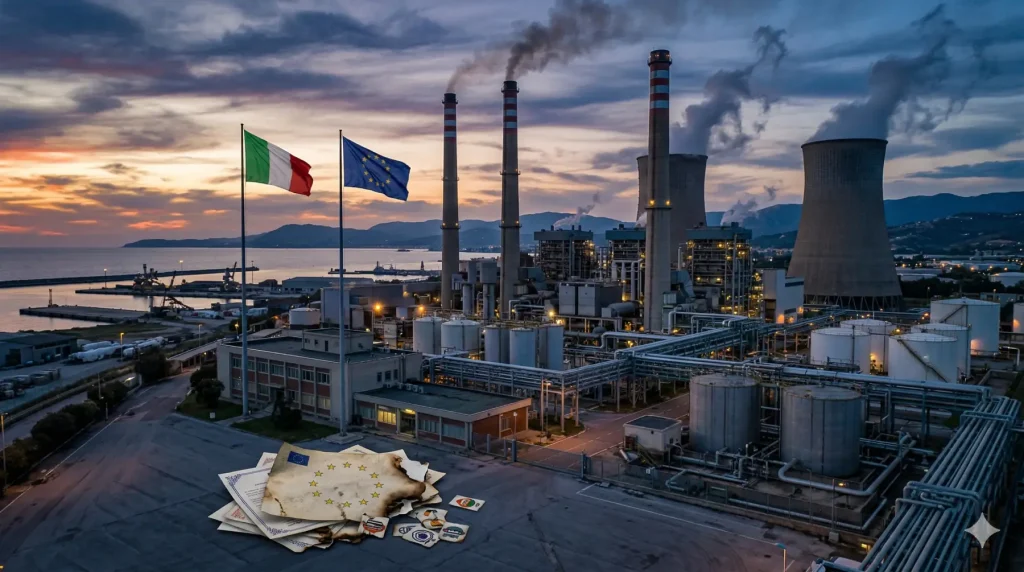
In recent months, the topic of the EU ETS (European Union Emissions Trading System) has returned to the center of the European debate—not only for its role in reducing emissions, but also for its direct impact on energy, industry, and transport.
It is a technical mechanism, yet one with very concrete consequences for the logistics system and business competitiveness. Understanding it means better interpreting the ongoing transformation of mobility and intermodality.
What the EU ETS is and how it works
The EU ETS is the main tool adopted by the European Union to reduce greenhouse gas emissions in the most energy-intensive sectors, including heavy industry and aviation.
The system is based on a “cap & trade” model:
- an overall emissions cap is set
- a corresponding number of emission allowances is issued
- companies must hold or purchase allowances equal to their emissions
- allowances can be traded on the market
Over time, the total number of available allowances decreases, progressively forcing companies to reduce their emissions. The European objective is clear: to achieve a reduction of over 60% by 2030 compared to 2005 levels.
Today, the system involves thousands of operators across Europe and a significant share of total emissions, making it one of the most impactful tools of European climate policy. Since 2024, it has also been extended to maritime transport.
An effective system under pressure
The principle behind the ETS is straightforward: the polluter pays, encouraging investment in cleaner technologies.
However, the context has changed. The system was designed before recent energy and geopolitical crises, which have significantly altered market dynamics.
In particular, rising energy prices have led several governments, including Italy’s, to call for a revision of the mechanism. According to the institutional debate, the ETS is currently contributing to increased electricity costs, with significant effects on businesses and production chains.
This has led to requests to temporarily suspend certain applications of the system while awaiting a broader revision.
ETS and logistics: an increasingly direct link
Although the ETS was not originally designed specifically for logistics, its effects are increasingly impacting the sector:
- rising energy costs
- pressure toward more sustainable transport models
- acceleration of technological transition
- need to rethink supply chains
In this context, intermodality becomes a strategic lever. Integrating rail and maritime transport makes it possible to reduce overall emissions while improving operational efficiency.
Intermodality as a concrete solution
The progressive tightening of European environmental policies makes one direction increasingly clear:
shifting part of freight transport from road to more sustainable modes.
However, achieving this requires operational tools—not just incentives.
In this context, having quick access to information on:
- intermodal terminals
- rail connections
- Ro-Ro routes
- European logistics corridors
becomes a real competitive advantage.
Digital tools such as the PortaleGenio WebApp allow companies to navigate the European intermodal ecosystem, evaluate real alternatives, and support more efficient and sustainable decision-making.
Toward a more balanced ETS
The current debate does not question the existence of the ETS, but rather its evolution.
At the European level, there is growing recognition of the need to update the system, making it more aligned with current economic conditions and better balanced between environmental objectives and industrial sustainability.
The challenge is clear:
reducing emissions without undermining business competitiveness.
Conclusion
The EU ETS is one of the pillars of European climate strategy, but its impact goes far beyond the environment—it directly affects energy, industry, and logistics.
For companies in the transport sector, the direction is now clear:
- greater integration between transport modes
- higher operational efficiency
- stronger focus on data and planning
In this scenario, understanding tools like the ETS and adopting solutions capable of navigating the complexity of the European logistics system is no longer optional—it is essential.
And intermodality, supported by advanced informational tools, represents one of the most concrete responses to this transformation.