


In a recent discussion among leading representatives of Italy’s Port System Authorities, the need for a centralized national strategy to manage the country’s complex port network emerged strongly. Moderated by Angelo Scorza, the event highlighted structural challenges, opportunities linked to the energy transition, and new geopolitical scenarios redefining the role of ports in the Mediterranean.
Ports as Geopolitical Sensors
Federica Montaresi, Commissioner of the Eastern Ligurian Sea Port Authority, emphasized how ports have become the first sensors of global change—economic as well as geopolitical. Continuous adaptability is now essential: “We can no longer think in local terms. Ports need rapid-response tools and flexible strategies, but they must be coordinated by a central intelligence.” Her comment underscores the need to overcome bureaucratic delays and fragmented decision-making that hinder infrastructure development.
To enable an integrated and strategic vision of transport routes, digital tools such as PortaleGenio can be highly valuable. With its detailed representation of the European intermodal network, the web app allows users to evaluate alternative routes and connection opportunities—both maritime and rail—helping Port Authorities make data-driven decisions.

Geopolitics and New Challenges
Pino Musolino (Port Authority of the Central-Northern Tyrrhenian Sea) warned against static thinking: “We live in a world of constant change. Global trade policies can shift overnight, as Trump’s recent remarks on tariffs for Chinese ships demonstrate.” In this context, Italian ports—thanks to their geographic location—could play a key role in the new global balance, but only if supported by a coherent national strategy.
Examples of Regional Reorganization
Francesco Di Sarcina, President of the Eastern Sicily Port Authority, shared Sicily’s experience in streamlining logistics: Catania now focuses on ferries, while Augusta specializes in commercial traffic. This model has worked thanks to the direct involvement of operators and a willingness to collaborate. “But does it make sense for neighboring cities to compete in the same segment, like cruises?” he asked, highlighting how a central strategy could prevent unnecessary duplication.
Energy Transition and Ports of the Future
The experience of Taranto, presented by Sergio Prete, Commissioner of the Ionian Sea Port Authority, was especially insightful. After a decline in traffic linked to the Ilva steelworks, the port began diversifying—investing in cruise tourism and, notably, offshore wind energy. “We are the only port in the Mediterranean with an operational offshore wind farm. It’s a real opportunity to develop a new industrial supply chain tied to the energy transition.”

The Need for Centralized Intelligence
To conclude, Massimo Deiana (Port Authority of the Sardinian Sea) shared a geopolitical perspective: with 18% of the Mediterranean coastline, Italy has both the right and the responsibility to play a strategic role. But to do so, it needs a strong governing body that can prioritize infrastructure investments. Not every port can become an international hub—specialization and systemic vision are essential.
From this perspective, PortaleGenio proves to be a strategic tool for port policy as well. By showcasing existing routes and interports, it supports planners in optimizing and enhancing freight flows—promoting a genuinely sustainable and efficient logistics system.
At the heart of the PortaleGenio experience lies a powerful, intuitive WebApp designed to simplify access to Europe’s intermodal ecosystem. Built around a detailed digital map of Europe and the Mediterranean basin, the app clearly displays key logistics structures such as interports, ports, and rail terminals. By clicking directly on the map or selecting a country from the side menu, users can access complete technical information—discovering each structure’s functions, features, and the companies operating within it.
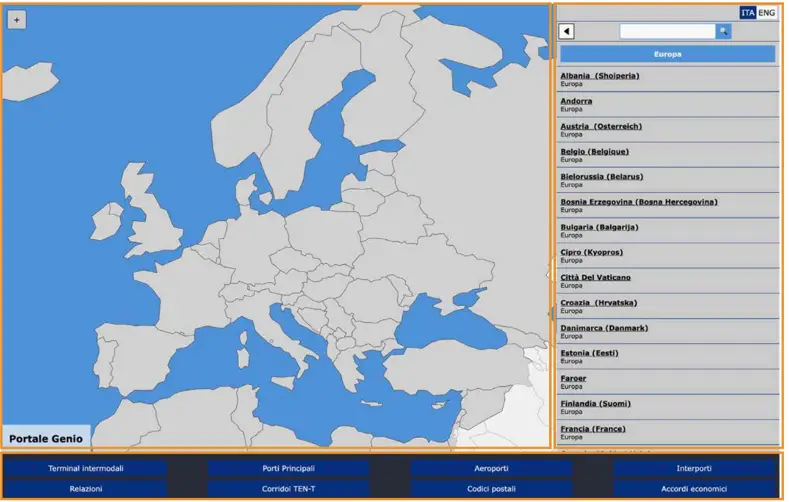
The app features a user-friendly interface with dedicated buttons for search, language selection (Italian/English), and thematic navigation. Users can explore intermodality through two paths: geographically, or by diving into one of eight core thematic categories.
With just a few clicks, PortaleGenio becomes a valuable resource for navigating the European logistics system, comparing transport solutions, and identifying new opportunities—all with clarity and precision.
Click here and start your journey!