



In recent months, intermodal transport has once again taken center stage in political and economic discussions, reaffirming itself as one of the most effective tools to pragmatically address the environmental and economic challenges facing both Europe and Italy. During a speech at LetExpo, Italian Undersecretary of State for Education and Merit Paola Frassinetti clearly stated that logistics is a strategic lever for the development of the national production system, highlighting the crucial role of intermodality in the shift toward a more efficient and sustainable model.

Environmental and economic benefits: intermodality at the heart of change
Intermodality—meaning the smart integration of different modes of transport (road, rail, sea)—is now one of the most concrete solutions to reduce greenhouse gas emissions in the freight mobility sector. Shifting a significant portion of heavy traffic from road to rail or sea means cutting energy consumption and drastically reducing CO₂ emissions. These environmental benefits are matched by greater overall efficiency in the logistics chain, with lower long-distance costs, improved punctuality, and reduced road congestion.
From an economic standpoint, intermodality offers companies a valuable opportunity to increase competitiveness by making supply chains leaner and more reliable. Businesses adopting intermodal solutions not only enhance their environmental performance, but can also benefit from incentives, tax breaks, and a stronger reputation—essential in international markets where sustainability has become a decisive factor for investors and clients.
PortaleGenio: a practical tool to plan and visualize intermodal transport
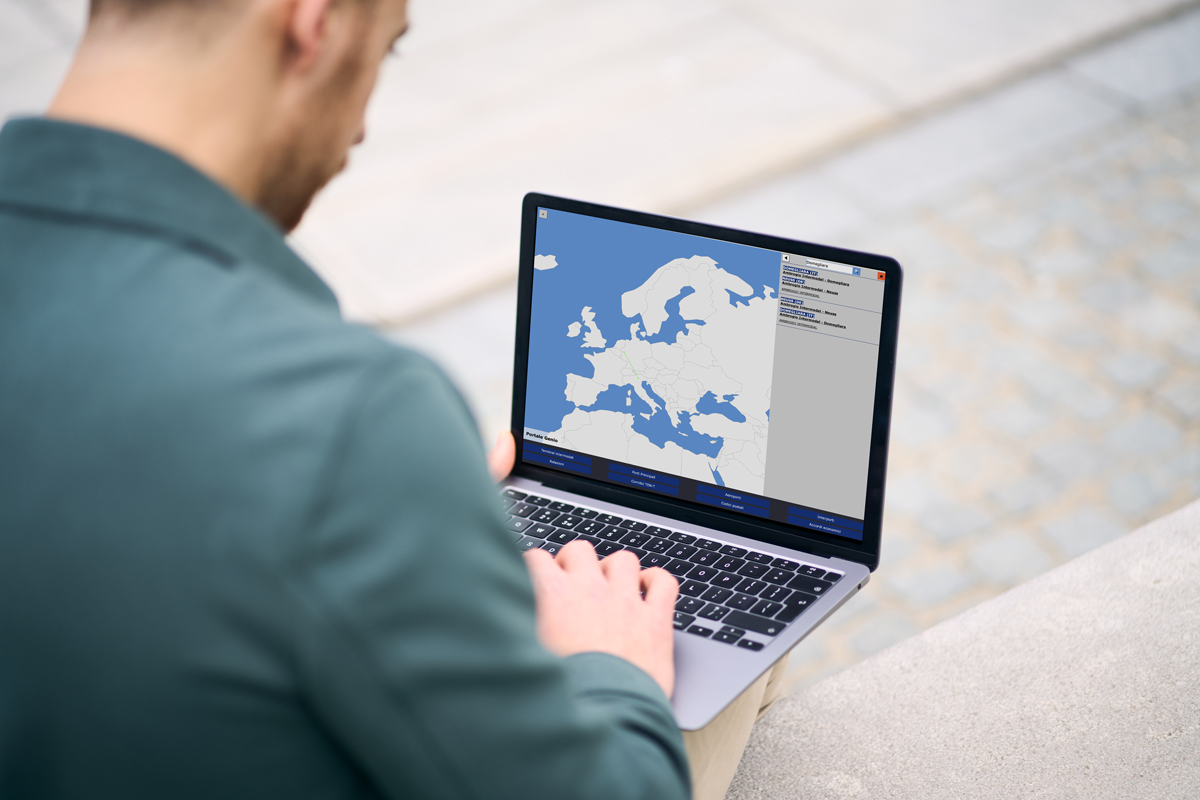
In this context, digital tools such as PortaleGenio are proving to be valuable allies. The WebApp provides a detailed view of active intermodal connections along the main European TEN-T corridors, mapping nearly 2,000 railway and Ro-Ro maritime lines in real time. Over 500 logistics facilities are included, each with clear and immediately accessible technical data, allowing users to easily assess routes, logistics hubs, and the most advantageous intermodal options.
For example, a company needing to regularly ship goods from northern Italy to Germany can quickly use PortaleGenio to evaluate whether a reliable rail alternative is available instead of traditional road freight—calculating the benefits in terms of emissions saved, costs, and transit times. Similarly, a logistics operator looking to offer a competitive intermodal service can identify the best facilities to partner with, thanks to a dedicated section highlighting companies already active in key intermodal nodes.
Another valuable feature is the integrated customs module, which provides updated information on trade agreements and preferential origin of goods for each represented EU country—helping streamline a phase that is often complex and delay-prone.
Conclusion
Intermodal transport is not a futuristic solution—it’s already a strategic, sustainable, and economically advantageous reality. For Italy’s logistics system to fully embrace these opportunities, action must be taken on several levels: political, industrial, and technological. In this landscape, informative tools like PortaleGenio can offer a discreet but decisive contribution, helping companies and logistics professionals transition toward a more efficient and connected transport system. A transformation that can no longer wait.